


Available in:
Fadel Abdulghany
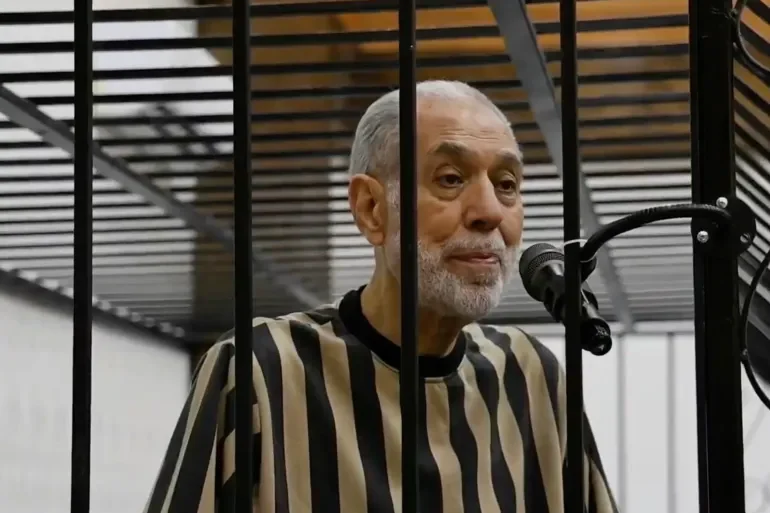
The trial of Ahmad Badreddin Hassoun (the mufti of the deposed Syrian regime) before the Fourth Criminal Court in Damascus raises a question that ordinary judicial prosecutions in atrocity cases rarely settle: how should we assess the responsibility of those who confer legitimacy upon violence without carrying it out?
For the standard model of accountability for war crimes and crimes against humanity focuses on the perpetrator: the soldier who fires the shots, the interrogator who practices torture, and the commander who issues the orders.
As for the case of Hassoun, it falls elsewhere; the prosecution doesn’t claim that he carried a weapon or issued operational orders, rather, his alleged contribution to the mass violence consisted of discourse, position, and the symbolic authority of an official religious office.
Hence, the ability of the Syrian courts to prosecute this form of contribution without sliding into a political theater is the conceptual problem opened by the first session of his trial, which commenced in Damascus on 25 June 2026.
The case is built on a theory of responsibility that international criminal law recognizes, however it finds difficulty in proving it with precision. For a system of atrocities isn’t composed only of those who carry out its violence; it also includes those who confer legitimacy upon that violence, mobilize the perpetrators through a discursive and institutional authority, and help remove specific civilian groups from the protection of law and morality.
The indictment claims, as presented in the first session, that Hassoun performed this function from the position of the Mufti of the Republic, through lectures he delivered before personnel of the army and the security services, public statements concerning the civilians of eastern Aleppo and Idlib, and the praise of foreign commanders and forces engaged in the conduct of hostilities or in supporting them.
As for whether these acts rise to the level of participation in war crimes and crimes against humanity, or remain a morally reprehensible political support that falls outside the scope of international criminal responsibility, that is the legal question the court must answer.
Legal Challenges
The jurisprudential difficulty begins with the legal status of incitement itself. For under Article 25(3)(e) of the Rome Statute, direct and public incitement is explicitly criminalized with respect to genocide.
As for war crimes and crimes against humanity, international criminal law generally doesn’t treat incitement as an independent pathway to responsibility. Speech in these contexts is prosecuted through the established modes of participation, such as ordering, soliciting, inducing, instigating, or aiding and abetting, as well as persecution when the speech contributes to a discriminatory attack.
Hence, if the Syrian court contents itself with saying that Hassoun incited atrocities, it will have said less than what is required.
It must therefore determine whether it is relying on the national crimes of incitement under the Syrian Penal Code alone, or on the international modes of participation in atrocity crimes. Conflating the two pathways would weaken the judgment and expose it to challenge on appeal.
The characterization that is most defensible from the perspective of international law, in light of the facts presented so far, is participation through instigating or aiding and abetting specific underlying crimes, with the possibility of treating persecution as a crime against humanity on political grounds as a second axis, but only if the discriminatory intent and the contextual nexus are established.
The Responsibility of Speech
Both theories require more than a merely offensive speech; they presuppose a provable relationship between the speech under accusation, a specific audience of perpetrators, the temporal frame of particular operations, and the underlying pattern of the crimes. From here, the lectures directed at officers and security personnel acquire a special legal weight.
For speech directed at armed actors during periods of unlawful violence can’t be assessed in the same way in which a scattered speech directed at a general audience is assessed.
The institutional position of the speaker amplifies the effect, however it doesn’t constitute, in itself, a basis for responsibility. For the position of the Mufti of the Republic involves a special form of authority: an authority that is religious, symbolic, and integrated into the apparatus of the state.
In speech-based responsibility, the authority of the speaker acquires importance, because it affects how the words are received, and whether they encourage those capable of practicing violence.
For a statement issued by a person capable of conferring a religious legitimacy upon the violent conduct of armed personnel travels differently than if an ordinary citizen had uttered the very same words.
Institutional authority, therefore, is a multiplying factor in the proof, not a substitute for the evidence. The court will still have to show that specific statements were capable of being received as an authorization, an encouragement, or a sanctioned mobilization, and that they were received as such in the context of their nexus to concrete crimes.
The gravest analytical risk lies in the over-expansion of the scope of causation. For the summary of the indictment, as reported from the first session, suggests that Hassoun’s statements contributed to mass death, enforced disappearance, and the destruction of cities. This framing is understandable politically, however it is fraught with risks legally.
For individual criminal responsibility requires a substantial contribution to specific crimes or specific criminal patterns, not a sweeping responsibility for the entire machinery of repression. The case only becomes viable when it is disciplined methodically, by linking each speech act under accusation to a specific charge, a precise legal theory, a particular audience, and an underlying pattern of crimes.
Proceeding judicially, incident by incident, will limit the claims of vagueness, and will render the trial a criminal adjudication of responsibility, not a retroactive political condemnation.
Hence, the trial of Hassoun represents a test of the ability of the new Syrian judiciary to prosecute one of the most conceptually complex forms of responsibility for atrocities: the responsibility of the non-executing actor who confers legitimacy upon mass violence and facilitates it.
Its success won’t be measured by conviction alone, but by whether the court will issue a reasoned judgment that distinguishes between national incitement and international participation, links each statement to a specific criminal pattern, and observes the principle of legality without substituting moral condemnation for legal reasoning.
If the trial is conducted in this manner, it may establish a Syrian precedent regarding the criminal responsibility of those who confer legitimacy inside the systems of atrocities. As for a trial conducted otherwise, it will satisfy the public anger without producing a model of accountability capable of standing before legal scrutiny.
