


Available in:
- English
- العربية
Introduction
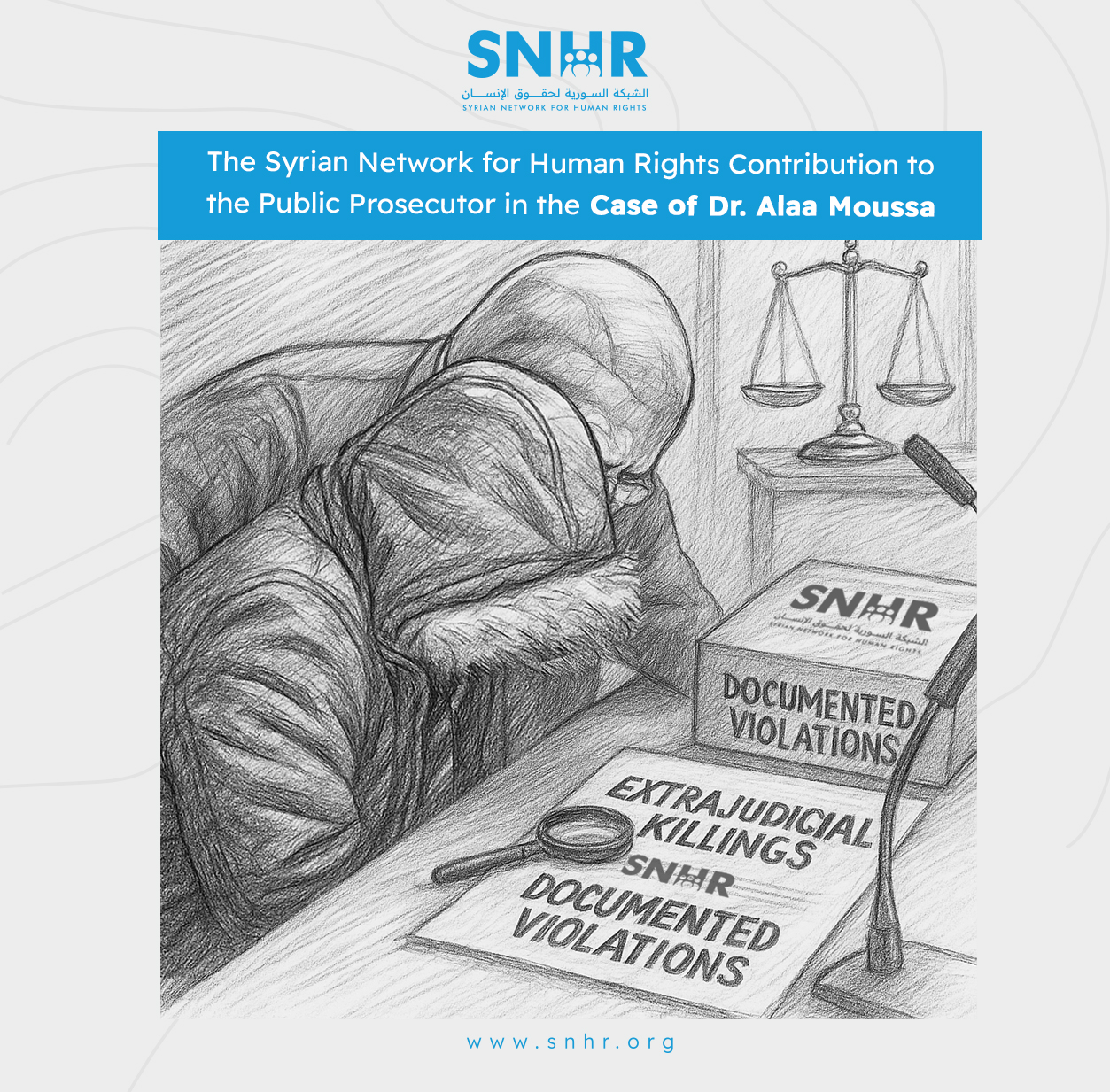
As part of its tireless efforts to document violations and hold those responsible accountable, the Syrian Network for Human Rights (SNHR) has submitted a set of documentary evidence to the Public Prosecution Office as part of the legal proceedings against Dr. Alaa Moussa, relating to alleged crimes committed during his tenure between 2011 and 2012. This contribution reflects the SNHR’s commitment to the principles of accountability and its determination to expose the systematic practices that have affected thousands of victims, particularly in places that were supposed to be havens of healing and care but have been transformed into scenes of torture and the killing of civilians under the guise of official medicine.
Nature and scope of evidence
- Documenting Deaths in Military Medical Facilities
Providing a list of the names of detainees who were transferred to military hospitals and subsequently died provides direct evidence of the systematic nature of the violations. This documentation helps reveal the links between detention, forced medical care, and deaths resulting from torture or deliberate medical negligence, both of which constitute serious violations of international humanitarian law.
- Records of Enforced Disappearances
A list of names of individuals last seen in military hospitals, whose fate remains unknown, was presented as evidence of the widespread and systematic practice of enforced disappearance, a crime against humanity perpetrated by the Assad regime. These records are particularly important because they corroborate survivor testimonies and demonstrate a recurring pattern of abuse within these facilities.
- Official Death Certificates
Death certificates issued by military hospitals for forcibly disappeared detainees are official state documents, revealing a fundamental contradiction that proves the regime’s own involvement in these crimes. These documents are of great importance in confirming the link between state institutions and individual criminal responsibility, strengthening the possibility of proving knowledge and participation in systematic attacks against the civilian population.
- Family Notification Documents
Handwritten notifications sent to families to collect the bodies of their relatives reveal the nature of the administrative procedures followed in cases of death in military hospitals, reflecting the existence of a bureaucratic system of violence within these institutions. These documents also help demonstrate the presence of criminal intent and the organizational policies necessary to hold the leadership accountable for these crimes.
- Visual Evidence of Torture
Video footage showing the torture of sick and wounded detainees inside a Homs military hospital constitutes direct physical evidence of war crimes and crimes against humanity. This type of evidence is effective in demonstrating both the perpetrators’ criminal conduct and the systematic nature of violations within military medical facilities.
Legal importance of evidence
- Confirming the systematic nature of practices: The violations documented by the Syrian Network for Human Rights demonstrate a pattern of crimes that goes beyond individual cases, supporting charges of crimes against humanity, which require proof of systematic or widespread attacks.
- Determining individual responsibility: Through evidence from within military medical institutions during the period in which Dr. Moussa worked, the documents help trace the levels of command or senior leadership responsibility, a crucial step in holding senior officials accountable.
- Strengthening witness testimonies: The documents provided provide objective support for survivors’ accounts, enhancing their credibility and overcoming the challenges associated with relying exclusively on individual testimonies.
- Proving the regime’s overall policy: The formal nature of many documents, such as death certificates and administrative notices, enables proof that violations were carried out as part of a state policy, a key element in proving crimes against humanity.
Conclusion
The evidence presented by the Syrian Network for Human Rights in the case of Dr. Alaa Mousa highlights the deep involvement in gross human rights violations within military medical institutions and reveals the systematic and methodical nature of these crimes. This documentation effort not only aims to support the judicial process and achieve justice for victims, but also contributes to establishing the principle of accountability and combating impunity. The Network reaffirms its commitment to continuing to document violations and providing all necessary data and testimonies to support judicial efforts to uncover the truth, provide redress for victims, and achieve transitional justice in Syria.
