


SNHR Documented 124 Cases of Arbitrary Arrest and Four Cases of Enforced Disappearance during al-Halabi’s Period of Heading the State Security Branch
Available in:
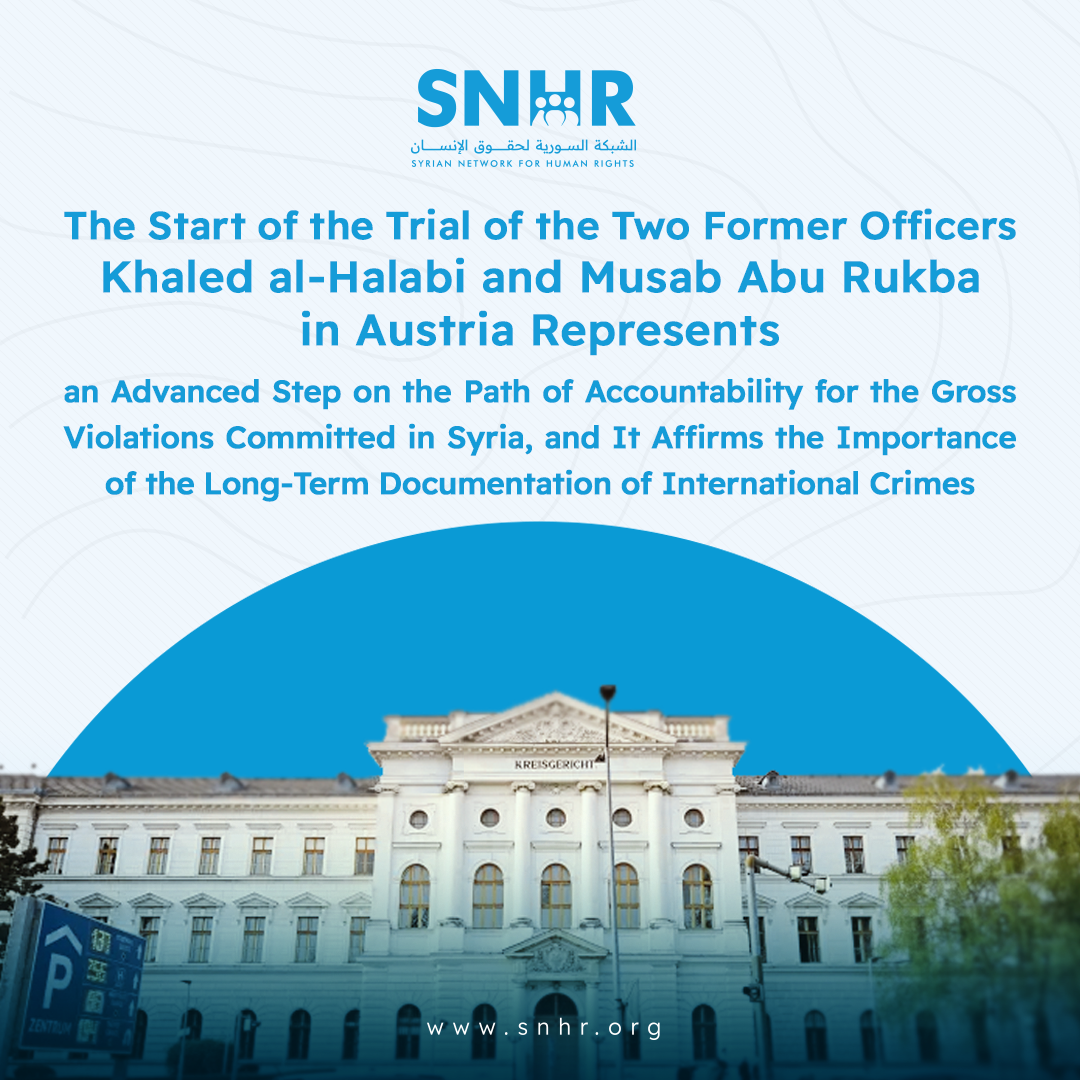
On 1 June 2026, the Regional Court in Vienna, Austria, opened the first sessions of the trial of the former Brigadier General Khaled al-Halabi, the former head of the State Security Branch (Branch 335) in Raqqa Governorate, alongside the former officer Musab Abu Rukba, who held the position of head of the investigations division in the criminal police in Raqqa Governorate, this being within the framework of applying the principle of universal jurisdiction to the gross international crimes committed in Syria.
This case is considered among the most prominent cases connected to accountability for the violations committed in Syria before the European courts, given the functional positions that the two defendants held within the security apparatus in Raqqa Governorate during the period extending between 2011 and 2013. It also acquires a special importance for the fact that it includes the trial of Khaled al-Halabi, who is considered among the most senior former Syrian security officials to have appeared before the European judiciary against the background of accusations relating to gross human rights violations committed during the Syrian conflict. It is likewise considered among the first cases in Austria in which the principle of universal jurisdiction is applied to foreign security officials accused of committing gross violations outside Austrian territory, which makes it an important legal precedent on the path of holding accountable those responsible for the violations in Syria.
The court is examining accusations relating to torture, coercion, sexual violence, and the causing of serious bodily harm against detainees and civilians in Raqqa Governorate during the period extending between 2011 and 2013. The two defendants pleaded not guilty to the charges attributed to them during the opening session, while the case is built on a wide file of evidence, testimonies, and documents that were gathered over years of investigations.
The Syrian Network for Human Rights affirms that this trial constitutes an important milestone in the international efforts aimed at combating impunity and achieving justice for the Syrian victims, and it also affirms the importance of continuing to pursue the officials in the Assad regime suspected of involvement in committing the crimes of torture, enforced disappearance, sexual violence, arbitrary arrest, and other gross violations that were committed in Syria since March 2011, which are crimes that are not extinguished by the statute of limitations. It also affirms that the preservation of evidence and the documentation of violations in a professional and independent manner remain two decisive factors in enabling the judicial authorities to pursue those responsible for them, even after the passage of many years since their commission.
The statement also reviewed the Syrian Network for Human Rights’ documentation efforts. The Network documented at least 124 cases of arbitrary arrest carried out by the State Security branch in the province, all of whom were later released. It also documented at least four cases of enforced disappearance attributed to the same branch during the same period.
The Network also collected testimonies from survivors of detention, documenting recurring patterns of torture, ill-treatment, and violations within security detention centers in Raqqa. This data was preserved in its documentation databases, which are used to support accountability and justice efforts.
The Syrian Network for Human Rights also supported investigative journalism efforts addressing violations related to Syrian security agencies by providing documented information and data concerning the institutional structure, operational contexts, and systematic violations.
