

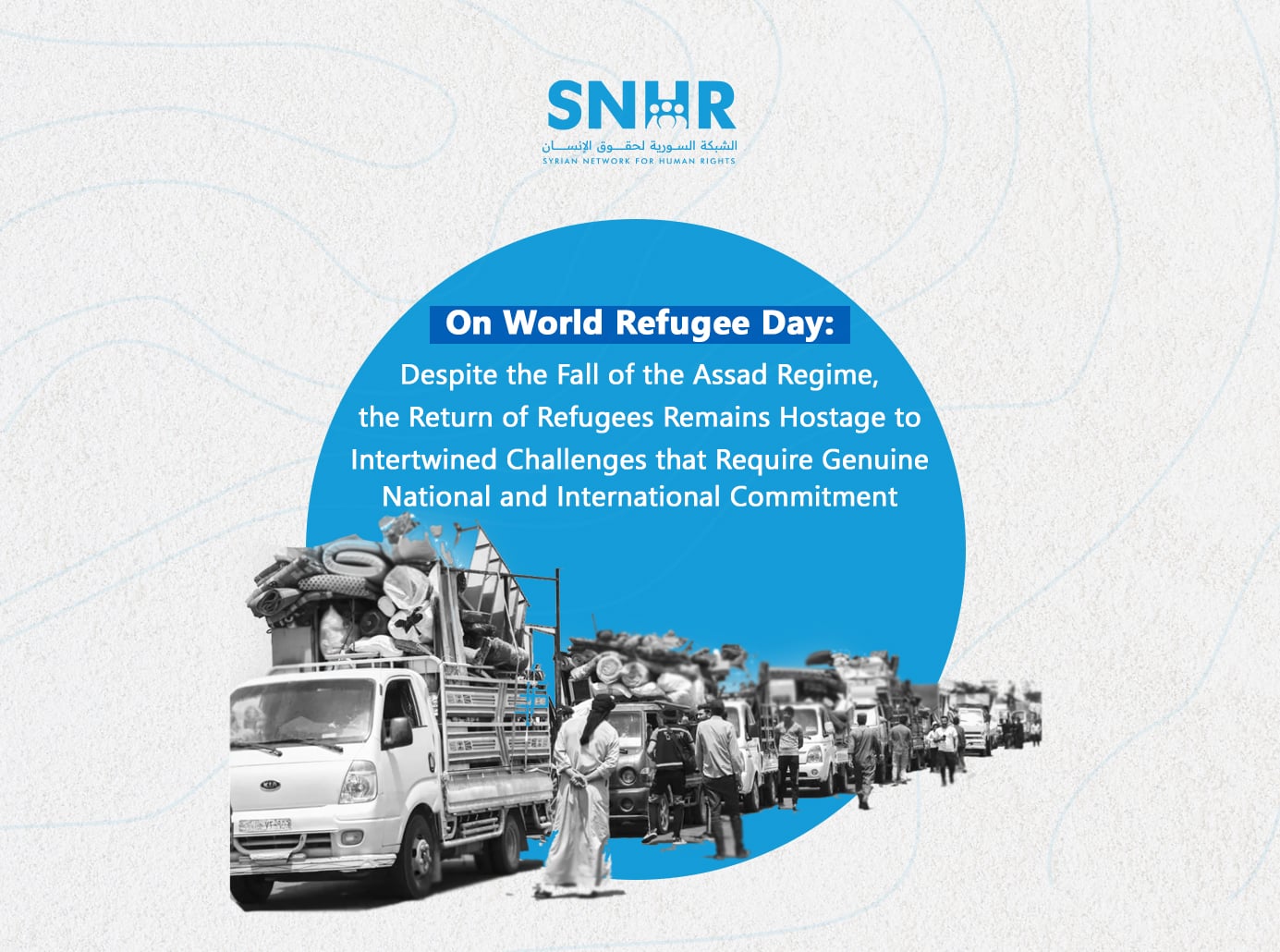
Achieving a Safe and Dignified Return Requires a Vision that Addresses the Legacy of Years of Destruction and Violations
Available in:
Damascus – June 20, 2025
The Syrian Network for Human Rights (SNHR) today released its annual report, marking World Refugee Day. The report examines the reality of the return of Syrian refugees and internally displaced persons (IDPs) after the fall of Bashar al-Assad’s regime and assesses the remaining challenges that continue to hinder their return despite the radical political transformations the country has witnessed. The report also presents a comprehensive vision for creating an environment conducive to voluntary, safe, and dignified return, built on the foundations of justice, accountability, and national and international partnership.
The report emphasized that the fall of the former regime on December 8, 2024, removed the most significant political and security obstacles that had prevented Syrians from returning for a decade. However, return still faces deep structural obstacles that require serious addressing at various levels, including legal, administrative, service, security, and economic.
In this context, the network, in cooperation with a number of immigration offices in countries of asylum, as well as international and local organizations, contributes to preparing reports and analyses on Syria as a country of origin for displacement, and assesses the availability of conditions for return in accordance with international standards.
The legacy of displacement: catastrophic figures and limited signs of return
By the end of 2024, more than 6.8 million Syrian refugees had fled abroad, and more than 6.9 million people were internally displaced, most of them living in conditions that lacked even the most basic protection or services. These unprecedented numbers have strained humanitarian response capacities and have had profound economic, social, and psychological impacts on millions of Syrians.
From the fall of the regime until mid-2025, approximately 500,000 refugees and 1.2 million internally displaced persons (IDPs) have returned, according to official sources from host countries, border crossing authorities, and the UNHCR. While these numbers offer hope, they represent only a small fraction of the total number of displaced persons and highlight the persistence of structural obstacles to achieving comprehensive return.
Obstacles Hindering Return: A Complicated Reality
Field reports from the Syrian Network for Human Rights highlight that returning refugees and displaced persons face an unprepared environment, suffering from:
- Legal and administrative obstacles related to property recovery due to loss of records or overlapping powers.
- High fees for official travel documents as fees for passports and civil documents remain extremely high, representing a real obstacle to refugees return.
- The full financial burden on returnees in light of the lack of support programs.
- Extensive destruction of housing, infrastructure, and basic services.
- Unexploded ordnance and damaged infrastructure: which have caused the deaths of at least 220 civilians, including 41 children and 10 women (one adult female), which threaten the lives of residents.
- Challenges associated with transitional justice processes in spite of the government establishing an official committee for that purpose.
- Variation in the ability of regions to welcome returnees due to the lack of planning or local stability.
- Local security disturbances and clashes resulting from undisciplined groups or former formations.
- Fragile economic conditions characterized by high poverty, poor services, and deteriorating education and health sectors.
- Inadequate international funding, as pledges did not exceed 12% of the announced needs for the 2025 returnee support plan.
The Syrian Network for Human Rights vision: An Internationally-supported National Plan
SNHR affirms that achieving safe and dignified voluntary return requires a comprehensive national approach and a genuine partnership with the international community, based on the following principles:
- Creating a legal and safe environment for return, through the independence of the judiciary and parliament, addressing obstacles related to property restitution.
- Rehabilitating infrastructure and basic services in areas of return.
- Activate the Transitional Justice Commission in an effective and independent role and ensuring the involvement of victims and civil society.
- Address security challenges and dismantling unruly groups.
- Launch fair economic policies that supports returnees and offer a chance for sustainable livelihood.
- Involve refugees and displaced persons in formulating policies related to their return.
- Ensure independent UN oversight of return programs.
Recommendations to concerned parties:
First: To the Syrian Transitional Government:
- Adopt a national return policy ensuring transparency, non-discrimination, and the effective participation of displaced persons.
- Issue clear and fair legislation to address property restitution issues.
- Launch immediate support programs for returnees, linking these programs to local recovery plans.
- Enhance local security in areas of return by deploying disciplined civilian security forces and seizing unregulated weapons.
- Ensure equitable representation of women and survivors of violations in decision-making processes.
- Ensure transparency in the management of international funding and cooperating with independent oversight bodies.
Second: To the United Nations and its agencies
- Establish an independent UN monitoring mechanism to monitor return conditions and document violations.
- Provide technical and technological support to the Syrian Transitional Justice Committee and support efforts for the cases of enforced disappearance.
- Fund comprehensive reintegration programs that include psychological support and economic empowerment.
- Expand partnerships with independent Syrian human rights organizations in documentation and monitoring.
- Develop special protection plans for the most vulnerable groups of returnees.
Third: To the countries hosting Syrian refugees
- Commitment to the principle of non-refoulement.
- Providing a safe legal environment for refugees, ensuring their access to services.
- Coordination with Syrian state missions to facilitate the issuance of official documents.
- Supporting awareness-raising programs for refugees about their rights and conditions of return.
- Providing protection for returnees at border crossings during periods of mass return.
Fourth: To donor countries and the international community
- Support the Syrian transitional government in its reconstruction efforts in a human rights’ framework.
- Linking funding for return and reconstruction to the principles of justice and accountability.
- Using political and diplomatic means to lift international obstacles to return.
- Supporting local initiatives aimed at promoting community reconciliation and funding peace-building projects.
On World Refugee Day, the Syrian Network for Human Rights affirms that return is not possible merely with the fall of the regime. Rather, it requires a comprehensive approach to addressing the legacy of displacement and violations. This is a collective responsibility that cannot be achieved without national political will, genuine international support, and a moral commitment to the dignity and rights of Syrian refugees.
