


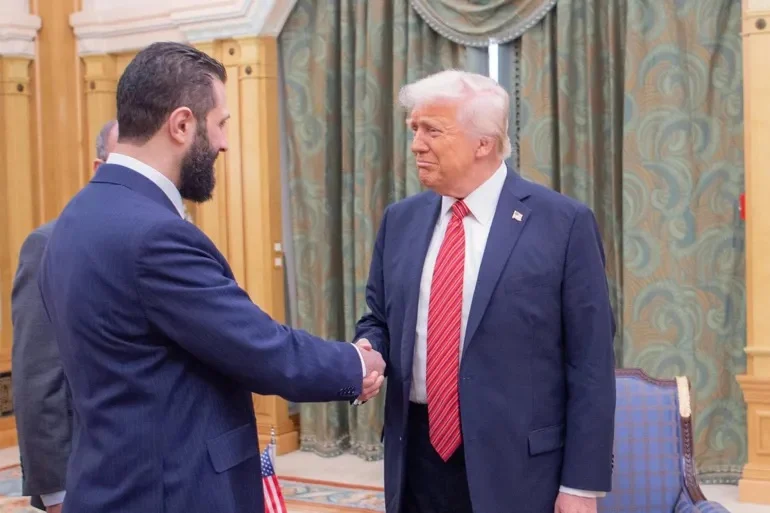
Trump (right) shakes hands with Al-Sharaa during a meeting between them in Riyadh (SPA)
Available in:
Fadel Abdulghany
President Donald Trump’s announcement in May 2025 regarding the lifting of US sanctions on Syria represents one of the most significant strategic shifts in US policy toward the Middle East in recent decades.
This move, which consists of a comprehensive package of sanctions relief through General License No. 25 issued by the US Treasury Department and a 180-day exemption issued by the State Department under the Caesar Act, reflects a profound shift from a long-standing policy of economic isolation to a deliberate approach to reintegration.
While these new policies offer unprecedented economic opportunities for Syria, they also pose complex legal, political, and implementation challenges that are likely to affect the nature of US-Syrian relations and regional stability for years to come.
Historical Development of the US Sanctions Regime (1979–2025)
The evolution of the US sanctions regime against Syria is a model of gradual escalation in the use of economic coercion, starting with limited measures during the Cold War and culminating in one of the most severe mechanisms of economic isolation in the contemporary history of international relations.
First: The Founding Phase (1979-2003)
US sanctions against Syria began in December 1979, when the United States designated Syria as a state sponsor of terrorism, a designation that has continued uninterrupted for more than four decades.
This designation came in the context of escalating regional tensions following Hafez al-Assad’s consolidation of power through an internal coup in 1970. Syria’s support for Palestinian factions and its anti-Western stance, in addition to its alignment with the Soviet Union, were the main motives for this designation.
At this stage, the sanctions were relatively limited, consisting of restrictions on US aid, a ban on defense and military exports, and controls on exports of dual-use materials. These measures formed the initial basis for subsequent expansion.
It should be noted that Syria remained the only country on this list from its establishment in 1979 until the sanctions were lifted in 2025.
Second: The legislative expansion phase (2003-2011)
The international climate following the attacks of September 11, 2001, and the subsequent expansionary policies of the George W. Bush administration in the Middle East, resulted in a significant tightening of the sanctions regime against Syria.
In May 2004, President Bush signed Executive Order 13338, implementing the Syria Accountability and Lebanese Sovereignty Restoration Act of 2003. This measure represented a significant shift in US sanctions strategy, from mere security tools to a means of widespread economic pressure.
The sanctions included a near-total ban on US exports to Syria (except for food and medicine) and strict restrictions on the Syrian banking sector, with the Syrian Commercial Bank being designated as an institution of concern in the area of anti-money laundering, leading to the severing of its ties with US banks. These sanctions helped to establish financial isolation as a key tool in US policy toward Syria.
These sanctions were based on accusations of supporting terrorism, interfering in Lebanese affairs, and developing non-conventional weapons. Despite the limited bilateral economic relations at the time, which did not exceed $300 million annually in 2004, these measures went beyond their direct economic impact to have a political and symbolic effect.
Third: The comprehensive embargo phase (2011-2020)
With the outbreak of the popular uprising in Syria in March 2011, the Obama administration adopted a policy of gradual escalation against the Assad regime, beginning with the issuance of Executive Order 13572 in April of that year, which expanded the previously imposed state of emergency to target those responsible for human rights violations.
This was quickly followed by Executive Orders 13573 and 13582, the latter (issued in August 2011) forming the cornerstone of a comprehensive economic embargo.
This decision included freezing all Syrian government assets, prohibiting economic dealings with Syrian government entities, halting US investments in Syria, and banning the import of Syrian oil. As a result, almost all official economic relations between the two countries were severed. In 2012, additional executive orders followed, targeting specific individuals and entities involved in human rights violations.
Fourth: Caesar Act (2020-2025)
In 2020, the Caesar Act for the Protection of Syrian Civilians, signed by President Trump in late 2019, came into effect.
This law brought about a qualitative shift in the structure of sanctions, extending them to include foreign entities and individuals who support the Syrian regime militarily or participate in reconstruction efforts.
The Caesar Act created a state of fear among international companies and institutions, which began to avoid engaging in any commercial activity with Syria for fear of US sanctions, further deepening Syria’s international economic isolation.
Fifth: Lifting sanctions
The initiative to ease sanctions came after a surprise announcement by President Trump on May 13, 2025, during the Gulf Cooperation Council summit in Riyadh, where Trump indicated his intention to “stop sanctions imposed on Syria to give it a chance to progress,” describing those sanctions as “extremely restrictive and very powerful.”
The Trump administration adopted a flexible approach that does not completely lift sanctions, but allows for immediate relief while maintaining the possibility of reimposing them if conditions worsen.
US Treasury Secretary Scott Pesant confirmed that “the ministry is working under new mandates aimed at encouraging investment in Syria,” stressing that “Syria is required to move forward toward becoming a stable and secure country.”
Sixth: Comprehensive Economic License
On May 23, 2025, the Office of Foreign Assets Control (OFAC) of the US Department of the Treasury issued General License No. (25) GL 25, which represents the biggest step toward easing sanctions on Syria in more than a decade.
This license suspends most of the previous sanctions stipulated in the Syrian sanctions regulations, allowing for a wide range of financial transactions that were previously prohibited.
The license covers three main areas: allowing the export of financial services to Syria, opening up new investment opportunities, and allowing transactions related to Syrian oil and its derivatives.
The license also covers the Syrian government led by Ahmad al-Sharaa, in addition to 28 key entities listed in the license appendix, including major banking institutions such as the Central Bank of Syria, the Commercial, Industrial, Real Estate and Agricultural Bank, and the Savings Bank.
These institutions are considered essential for rebuilding financial confidence, managing government salaries, and operating public utilities.
In the context of reintegrating the financial system, General License No. 25 represented a major breakthrough in Syria’s long financial isolation, lifting restrictions on vital financial institutions, particularly the Central Bank of Syria, which had previously been denied access to the international financial system and foreign currencies.
In a complementary measure, the Financial Crimes Enforcement Network (FinCEN) issued a special exemption under the Patriot Act allowing US banks to open correspondent accounts with the Syrian Commercial Bank after a freeze that had been in place since April 2006. This move facilitates reconnection between the Syrian and international banking sectors and reduces legal complexities related to compliance.
Exemption from the Caesar Act: Legal Restrictions and Executive Response
The Caesar Act differs in its legal nature from executive sanctions issued by presidential decrees, which can be more easily amended or suspended. The Caesar Act is considered legislation issued by Congress, requiring explicit legislative intervention to be permanently repealed.
Secretary of State Marco Rubio acknowledged this legal reality, explaining that the current exemptions are limited to a period of 180 days and calling for legislative action to ensure the permanent termination of these sanctions.
The US State Department has issued a temporary 180-day exemption that provides legal cover for non-US citizens participating in economic activities permitted under General License 25.
Secretary Rubio explained that the goal of this step is to encourage investment and financial flows that support basic services and reconstruction efforts in Syria, affirming the United States’ unwavering commitment to supporting the Syrian people in building a more stable and prosperous future.
This temporary exemption provides important legal space for economic engagement, while acknowledging the political and legal complexities involved in obtaining a permanent legislative exemption.
Despite the broad scope of General License 25, it clearly excludes transactions involving Russia, Iran, and North Korea, with the aim of preventing these countries from benefiting directly or indirectly from the reopening of the Syrian economy.
The license also maintained restrictions on hundreds of individuals and entities listed on the Specially Designated Nationals (SDN) list, most of whom are directly or indirectly linked to the Assad regime.
The license confirmed that the freezing of assets or property frozen on May 22, 2025, will continue, unless special licenses are subsequently issued allowing the freeze to be lifted.
Export Control Considerations
Despite the broad financial restrictions relief under General License 25, restrictions on exports of dual-use goods and technology, which are overseen by the US Department of Commerce’s Bureau of Industry and Security (BIS), remain unchanged.
This regulatory reality creates an overlapping and complex legal environment, as financial transactions are generally permitted, while technical restrictions on goods and technology remain in place. As a result, companies wishing to enter the Syrian market face additional challenges in balancing the easing of financial sanctions on the one hand and continuing restrictions on technical exports on the other.
Political and strategic dimensions
This new policy of easing sanctions represents a significant shift in the US strategy toward the Middle East, marking a clear transition from a punitive isolationist approach to a deliberate reintegration strategy, using economic tools to achieve strategic security objectives without completely abandoning available leverage.
This policy contributes to creating a favorable investment climate that could lead to enhanced local stability and provide economic incentives that support social stability and reduce the motives for violence.
From a geopolitical perspective, this strategy also aims to give US companies an early opportunity to participate in reconstruction in important sectors, such as oil, construction, telecommunications, and public services, which may help counterbalance the growing influence of Russia, Iran, and China in Syria’s recovery phase.
Conditional participation framework
The easing of sanctions has been implemented within a clear and specific framework of conditions, requiring the new Syrian government to commit to protecting the rights of religious and ethnic minorities and not providing safe havens for terrorist organizations.
The US Treasury Department has emphasized that these concessions will remain conditional and that the administration will closely monitor developments on the ground, reserving the full right to reimpose sanctions if the specified conditions are not met.
International financial institutions also face particular challenges in rebuilding relations with the Syrian banking sector, which requires significant internal reforms to enhance transparency and ensure compliance with international financial standards.
The process of reintegrating the Syrian economy into the international financial system is expected to be gradual and dependent on rebuilding trust and establishing effective oversight and risk management mechanisms.
Economic implications and opportunities
General License 25 provides unprecedented opportunities for the US private sector to participate in Syria’s reconstruction efforts by allowing new investments in all economic sectors after a long period of economic isolation.
This development contributes to addressing the cash flow crisis that Syria has experienced as a result of the freezing of official banking channels and the resort to informal channels and cash to conduct daily economic affairs. The license enables public and private institutions to restart banking payment mechanisms, payroll systems, financing programs, and lending.
In this context, the new Syrian government faces the delicate task of restoring confidence in the national monetary system, including moving currency production from Russia, which is subject to sanctions, to new cooperation agreements with Germany and the United Arab Emirates.
Allowing financial transactions related to Syrian oil and its derivatives is also one of the most prominent items in General License No. 25, as it opens the door to significant financial flows that could significantly support the Syrian government’s budgets. This opening also provides extensive investment opportunities in the energy sector and lays the foundation for the revival of oil trade relations between Syria and its international partners.
Timetable for gradual implementation
The sanctions relief process has been characterized by a gradual approach that balances regulatory flexibility with caution in implementation. The 180-day temporary exemption under the Caesar Act allows for periodic review by the United States of the new Syrian government’s compliance with the stipulated conditions.
While this approach allows for some flexibility, it also maintains a state of uncertainty, which hinders long-term investment planning.
The Office of Foreign Assets Control (OFAC) has announced plans to issue additional guidance on the application of General License 25, confirming that the implementation process will remain fluid and require ongoing adjustments based on developments on the ground, providing a mechanism for correcting potential errors but also increasing uncertainty in the early stages of implementation.
Conclusion: The Trump administration’s decision to lift US sanctions on Syria marks a historic turning point in US-Syrian relations and a great opportunity for the Syrian economy to rise from the ashes.
In practical terms, the success of this step depends on striking a delicate balance between ensuring the new Syrian government’s compliance with US conditions, gradually building trust with international financial institutions, and managing geopolitical competition with other regional and international powers.
It also requires addressing the structural challenges of the Syrian economy, particularly reforming the banking sector, restoring confidence in the local currency, and rebuilding the infrastructure destroyed by the war.
