


329 Civilians Have been Killed since the Fall of the Assad Regime, including 65 children, and 47 Deaths Have been Documented during Mine Clearance Operations
Available in:
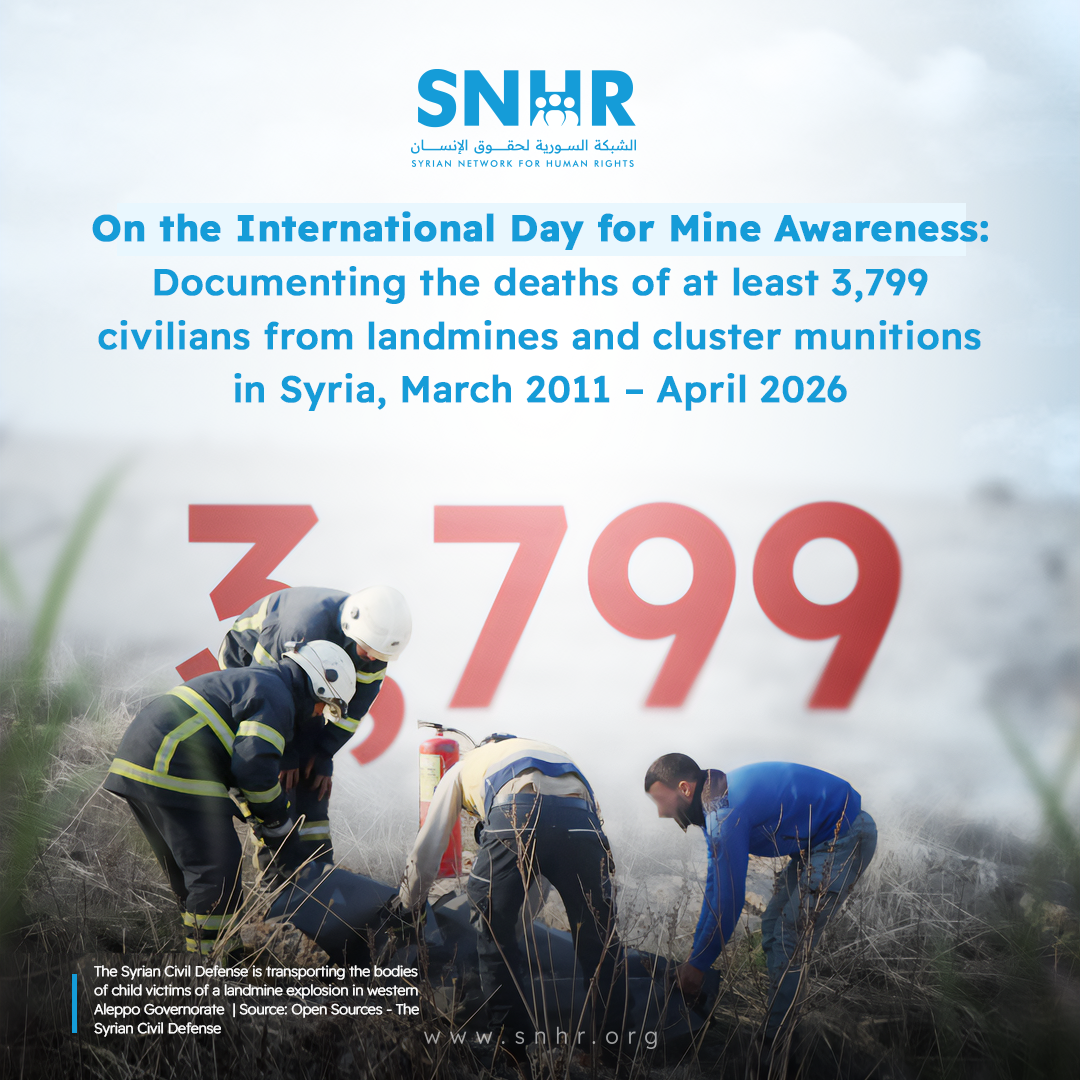
Damascus, April 4, 2026: The Syrian Network for Human Rights issued a report on the occasion of the International Day for Mine Awareness, documenting the killing of at least 3,799 civilians, including 1,000 children and 377 women, as a result of landmine explosions and cluster munition remnants in Syria during the period from March 2011 to April 2026. The report indicated that 329 civilians, including 65 children and 29 women, have been killed since the fall of the Bashar al-Assad regime on December 8, 2024.
Casualty Figures and Their Distribution
According to the report, 3,398 civilians were killed by landmine explosions, including 862 children and 343 women. Cluster munition remnants killed 401 civilians, including 138 children and 34 women. Children constitute approximately 26% of all landmine victims, while women represent about 10%, reflecting the indiscriminate nature of these weapons, which, once deployed, make no distinction between combatants and civilians.
In terms of geographical distribution, approximately 63% of landmine victims were concentrated in the governorates of Aleppo (814 deaths), Raqqa (676), Deir Ez-Zour (645), followed by Hama (342), Daraa (274), and Idlib (222). As for cluster munition victims, approximately 84% were concentrated in the governorates of Aleppo (94), Idlib (87), Hama (84), and Daraa (70). SNHR’s database confirms that the forces of the Bashar al-Assad regime and Russian forces carried out most of the cluster munition attacks that left behind these remnants.
The report documented a significant increase in landmine casualties following the fall of the Assad regime, coinciding with the return of growing numbers of displaced people to their homes and the resumption of agricultural activities. Incidents recorded after the fall of the regime included explosions during plowing, truffle hunting, and children tampering with unidentified remnants of war.
The Network estimates that at least 10,600 civilians have sustained injuries of varying severity, many of whom require prosthetic limbs and long-term rehabilitation services.
Clearance Operations: An Additional Source of Losses
SNHR documented the deaths of 47 people during demining operations since the fall of the Assad regime, including 40 members of the Syrian Ministry of Defense’s engineering teams. The report noted that these operations are conducted in the absence of official minefield maps, and that most of the teams lack the specialized training and technical equipment necessary according to international mine action standards. Furthermore, there is still no comprehensive national program for managing clearance operations.
Fadel Abdulghany, SNHR’s Executive Director, said: “These figures represent the minimum of what has actually occurred. Vast areas of Syrian land remain contaminated with undiscovered and unmarked mines. The fact that clearance operations themselves have become a source of death, with 47 people killed during demining efforts, reveals the gap between field needs and available resources. This necessitates the establishment of a national coordination structure and the provision of systematic training and appropriate equipment for the teams working on the ground.”
He added: “The Syrian government has a legal and moral obligation to accede to the Ottawa Convention and the Convention on Cluster Munitions, and to establish a mechanism for compensating and rehabilitating victims within the framework of transitional justice. The international community is also required to provide sustained technical and financial support commensurate with the scale of the contamination caused by more than fourteen years of conflict.”
Legal Framework
International humanitarian law prohibits indiscriminate attacks that fail to distinguish between military targets and civilians. The 1997 Ottawa Convention provides a comprehensive ban on antipersonnel mines, while the 2008 Convention on Cluster Munitions prohibits their use. Syria is not a party to either convention. However, the use of these weapons in populated areas constitutes a violation of customary international humanitarian law and may amount to a war crime under the Rome Statute if the perpetrator knows that the attack will cause excessive civilian casualties. International law guarantees victims the right to effective remedies and appropriate reparation, including compensation, rehabilitation, and guarantees of non-repetition.
Recommendations
The report called on the Syrian government to accede to the Ottawa Convention and the Convention on Cluster Munitions, establish a national mine action authority to coordinate, plan, and oversee mine action in accordance with international standards, conduct a comprehensive field survey to identify contaminated areas and mark them with warning signs, and establish a national mechanism for victim compensation and rehabilitation within the framework of transitional justice. It also called on the United Nations and the international community to allocate sufficient and sustainable financial resources to support mine clearance projects in Syria, provide specialized training and equipment for field teams, and support accountability mechanisms through the International, Impartial and Independent Mechanism and the Independent International Commission of Inquiry on Syria.
About the Syrian Network for Human Rights
The Syrian Network for Human Rights (SNHR) is an independent human rights organization founded in June 2011. It works to promote human rights in Syria through a multi-stage verification methodology. The Network is a trusted source for United Nations bodies, various governments, and international media outlets. It is a member of the International Cluster Munition Coalition and the International Campaign to Ban Landmines.
