


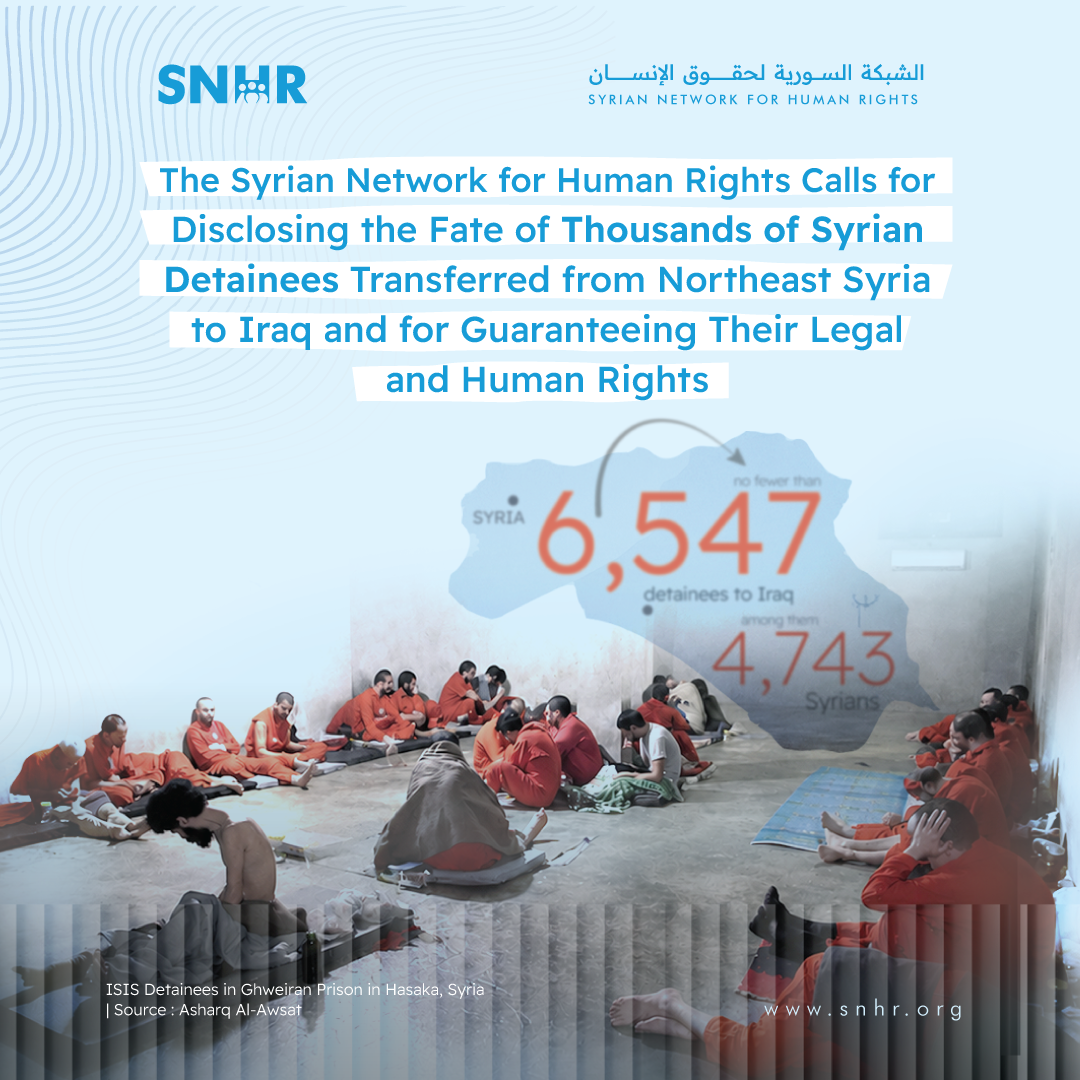
The Syrian Democratic Forces transferred no fewer than 6,547 detainees to Iraq, among them 4,743 Syrians, including dozens of children and adolescents, and 1,804 foreigners from nearly 61 nationalities
Available in:
Damascus – In a brief report, the Syrian Network for Human Rights revealed large-scale transfers and handovers of detainees who were held by the Syrian Democratic Forces and the bodies affiliated with the Autonomous Administration in northeast Syria to the Iraqi government, from 2019 up to the last period in which the detention centers concerned were under the control of the Syrian Democratic Forces.
According to the information documented by the Network, these operations involved no fewer than 6,547 detainees, among them 4,743 Syrian citizens, including dozens of children and adolescents, in addition to 1,804 foreign detainees who belong to nearly 61 Arab and foreign nationalities. These persons were detained against the background of the suspicion of belonging to, or being affiliated with, ISIS. These figures represent the minimum number of cases that the Network was able to document and verify in accordance with its adopted methodology.
The Syrian Network for Human Rights pointed out that the transfers were carried out in successive stages and separate batches, within the framework of security arrangements and bilateral coordination, without any comprehensive official announcement that includes the lists of names of the transferees, the transfer dates, the receiving bodies, or the legal and procedural basis for each operation. Likewise, there isn’t sufficient information about whether the transfer decisions were issued individually, or on the basis of an independent judicial review, or after enabling the detainees to challenge them or to obtain legal assistance.
The Network affirmed that the transfer of thousands of detainees across the border, in light of the absence of sufficient information about the conduct of individual risk assessments or independent judicial review, raises serious concerns relating to the principle of non-refoulement set out in Article 3 of the Convention against Torture, and to the fair-trial guarantees secured in Article 14 of the International Covenant on Civil and Political Rights. It stressed that the prohibition of return to the danger of torture is an absolute obligation that may not be overridden under the pretext of counter-terrorism or national security.
The Network noted that the file includes dozens of children and adolescents who were transferred within some of the batches, which requires observing the Convention on the Rights of the Child and the principle of the best interests of the child, and not dealing with children on the basis of collective suspicion, family affiliation, or presence in areas that were under the control of ISIS. It also affirmed the necessity that any legal or administrative handling of these cases take into account the possibility that the children are exposed to recruitment, exploitation, coercion, or coercive circumstances, and that it guarantee for them appropriate protection and legal, psychological, and social assistance.
The Network warned that reliance on confessions extracted under torture or coercion, or on general security information that isn’t susceptible to judicial testing, doesn’t conform to fair-trial standards. It affirmed that the suspicion of belonging to ISIS, however grave it may be, isn’t by itself sufficient to convict any person or to transfer him to the jurisdiction of another state without sufficient legal and procedural guarantees, including individual assessment, the right to a defense, independent judicial review, and the examination of the evidence presented against him.
The Network clarified that the transfer of detainees across the border without a clear system for preserving records and evidence threatens a break in the chain of custody of the evidence relating to detention, investigation, and transfer, including biometric data, the interrogation records, the referral records, the handover records, the medical records, and any allegations of torture or ill-treatment. This may lead to weakening the pathways of future accountability and transitional justice in Syria, and to depriving families of their right to know the fate of their relatives.
The Syrian Network for Human Rights affirms that counter-terrorism, and holding accountable those responsible for the crimes attributed to ISIS, don’t justify the mass transfer of detainees, nor do they exempt any party from respecting the guarantees of non-refoulement, fair trial, the prohibition of torture, the protection of children, and the right of families to know the fate of their relatives. It also affirms that this file must be part of the priorities of transitional justice in Syria, including the disclosure of the truth, the preservation of records, ensuring accountability, and preventing the loss of evidence or its selective use.
In its report, the Network calls on all the parties concerned to assume their responsibilities, in particular:
First: The Syrian Transitional Government
The Network recommended that the Syrian Transitional Government establish a comprehensive central national register of all the Syrian citizens who were transferred to Iraq since 2019, that includes the basic data, the places of detention, the legal status, and the trajectory of each case. It also called on it to open official channels of communication with the Iraqi government to obtain complete and up-to-date lists of names, to establish a national unit specialized in the file of the Syrian detainees transferred abroad, and to include this file within the pathways of transitional justice, encompassing the disclosure of the truth, the preservation of records, accountability, and ensuring that the evidence isn’t lost or used selectively.
Second: The Iraqi Government
The Network called on the Iraqi government to guarantee humane treatment for all the detainees, to respect their right to a defense, to enable them to communicate with lawyers and their families, and to conduct an individual judicial review of all the files, particularly the cases that rest on confessions, general intelligence information, or security reports that aren’t susceptible to judicial testing. It also demanded that confessions extracted under torture or coercion not be used, that the execution of any death sentence against any person transferred from Syria be suspended until an independent and effective review of his file is conducted, and that all the records and evidence relating to the transferred detainees be preserved.
Third: The Syrian Democratic Forces and the Autonomous Administration
The Network demanded that the Syrian Democratic Forces and the bodies affiliated with the Autonomous Administration fully disclose all the transfer and handover operations that took place since 2019, including the lists of names, the transfer dates, the receiving bodies, the legal or security basis for each operation, and the procedures that preceded the transfer. It also called on them to hand over the detention, investigation, and transfer records to the competent official Syrian bodies within a clear legal framework, while guaranteeing the preservation of authenticated copies that allow their use in disclosing the truth and in accountability.
Fourth: The International Parties That Participated in or Facilitated the Transfers
The Network urged any international body or foreign force that participated in organizing, facilitating, financing, or monitoring the transfer operations to disclose the nature of its role and the guarantees it adopted prior to the transfer, and to state whether it conducted or requested individual risk assessments, and whether it followed up on the situations of the persons included in the operations after their handover to the Iraqi government. It stressed that participation in the transfer, or its facilitation, requires verifying that the transferees aren’t exposed to the danger of torture, ill-treatment, an unfair trial, or execution.
Fifth: The United Nations and International Mechanisms
The Network called on the United Nations and the relevant international mechanisms to support the establishment of an effective mechanism for disclosing the fate of the transferred detainees, monitoring their legal and humanitarian situations, following up on the trial and detention procedures, and providing technical support for the establishment of reliable databases. It also called for strengthening cooperation with the International, Impartial and Independent Mechanism, particularly with regard to the preservation of the evidence that may be relevant to international crimes committed in Syria or to violations that occurred during detention, transfer, or trial.
