


Available in:
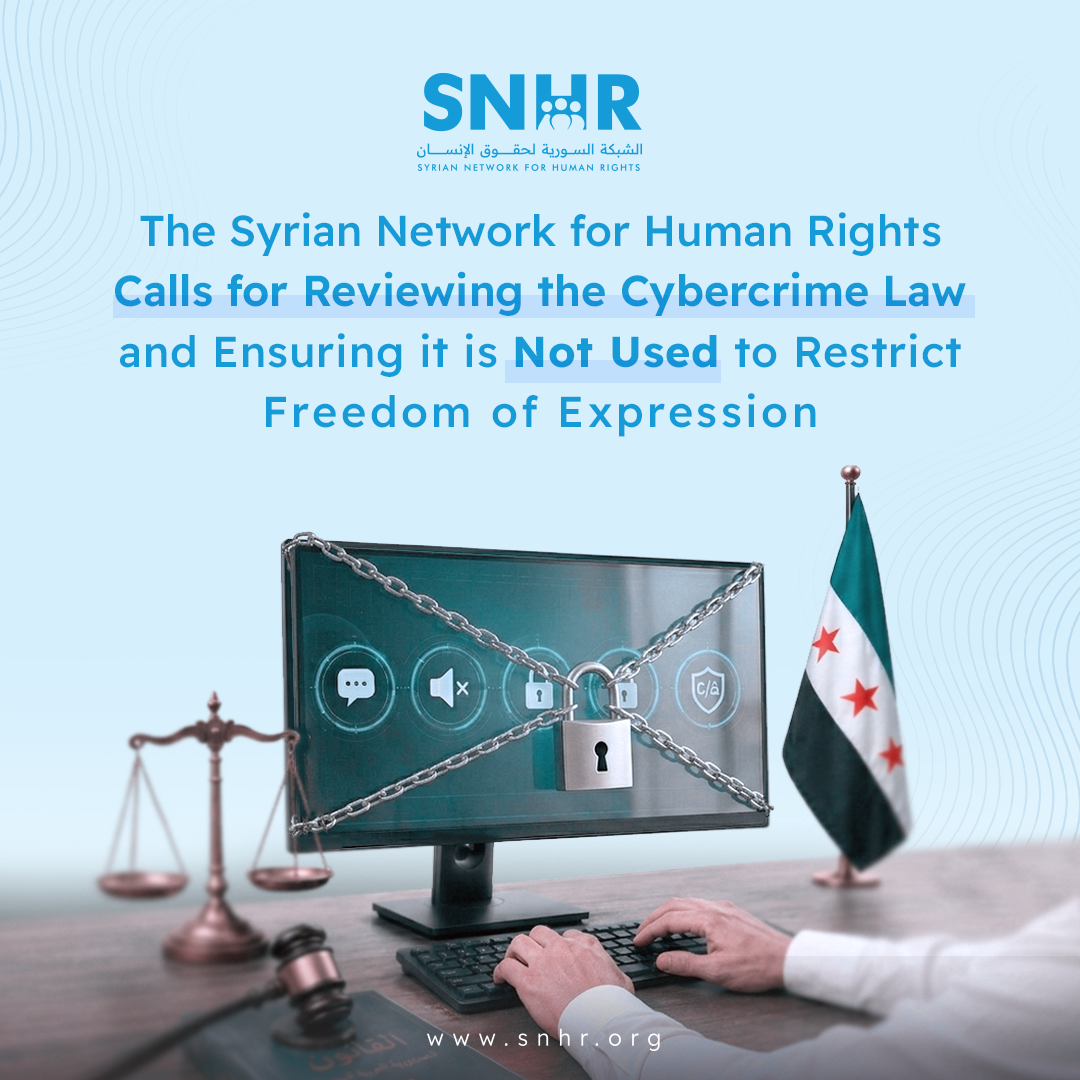
Damascus – The Syrian Network for Human Rights (SNHR) calls for a review of the Cybercrime Law No. 20 of 2022 and of its enforcement mechanisms, particularly in cases related to digital content and to freedom of opinion, expression, and public debate, in a way that ensures its harmonization with the Constitutional Declaration issued on 13 March 2025, with the international human rights standards, and with the principles of legality, necessity, proportionality, and effective judicial oversight.
SNHR affirms that combating cybercrime and protecting digital security are two legitimate aims that don’t conflict with protecting freedom of expression, the right to privacy, and fair-trial guarantees, so long as the legal provisions are precise and clear, and are applied within a narrow and proportionate scope, in a way that prevents the use of penal criminalization to restrict peaceful expression or to limit legitimate civic participation in public affairs.
On the evening of Wednesday, 17 June 2026, the Internal Security Forces affiliated with the Ministry of Interior in the Syrian government arrested the content creator Hassan Akkad in the city of Damascus. According to information obtained by SNHR, and based on the press statement issued by the Public Prosecutor in Damascus on 18 June 2026, the arrest came against the background of a legal complaint relating to charges of defamation, slander, and libel via the electronic network, after the claim was studied by the Public Prosecution specialized in cybercrime, and was referred to the competent authorities to complete the investigations in accordance with legal procedures. On Sunday, June 21, 2026, SNHR have documented the release of Hassan after the withdrawal of the complaint against him.
While adjudicating individual incidents and determining legal responsibilities remains within the jurisdiction of the competent judicial authorities, SNHR affirms that this incident, and the context of applying the Cybercrime Law in cases related to digital content, raise serious concerns about the dividing lines between cybercrimes that affect systems, data, and digital security on the one hand, and acts associated with freedom of opinion and expression, peaceful criticism, and the circulation of information across the digital space on the other hand.
Without asserting at this stage the nature of the content subject to the complaint, or the extent to which the penal provisions apply to it, SNHR believes that the case highlights the need for a legislative and procedural review that ensures the scope of the Cybercrime Law isn’t expanded to cover patterns of peaceful expression or public debate, and that custodial measures aren’t resorted to except where there are specific, necessary, and proportionate legal justifications, subject to effective judicial oversight.
