


Available in:
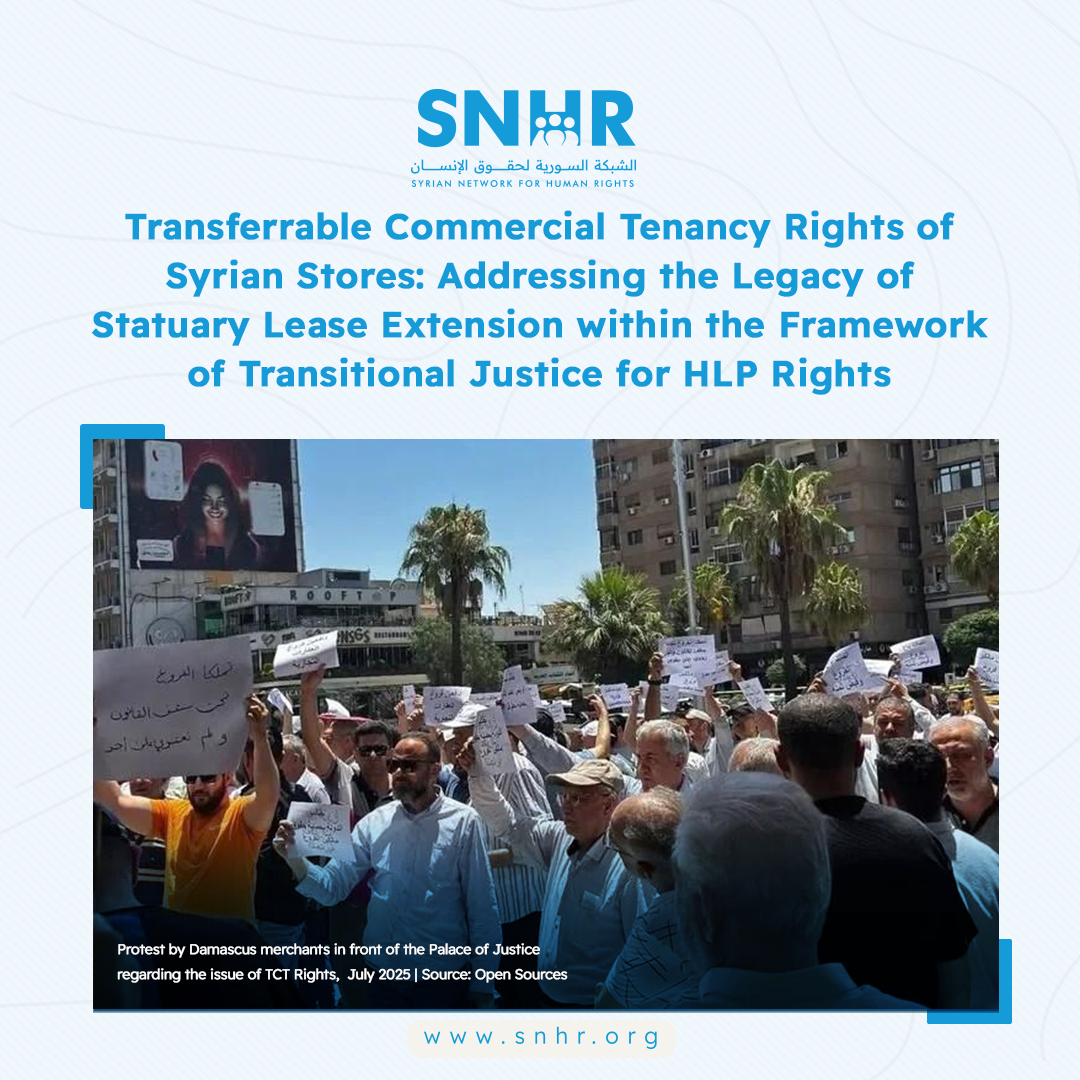
Damascus – The Syrian Network for Human Rights issued a report addressing the phenomenon of Transferrable Commercial Tenancy Rights (TCT) in shops and commercial properties as a direct result of a structural imbalance in the exceptional rental laws in Syria since the middle of the twentieth century, especially the system of arbitrary extension that practically stripped the owner of the right to use, exploit and dispose of, and turned the rental contract into a semi-permanent relationship with low rents. This was in a report titled Transferrable Commercial Tenancy Rights of Syrian Stores: Addressing the Legacy of Statutory Lease Extension within the Framework of Transitional Justice for HLP Rights.
In this context, TCT emerged as a customary solution to compensate tenants and restore some balance, so the tenant gained an actual economic right in the store while the owner retained ownership of the property. The importance of this issue is highlighted now in light of the political change and the formation of an official committee to review legislation, and the controversy that accompanied this regarding the ‘cancellation of TCT rights’. The report warns against any hasty action that could lead to further injustice against those who paid high TCT rights based on prior legal stability. It concludes that the issue must be integrated into a comprehensive national policy on housing and property rights, one that recognizes the compensatory function of TCT rights, adopts flexible mechanisms for proof, and achieves a balance without causing legal or economic shock.
The report adopts a composite methodology that combines a comprehensive legal analysis of Syrian rental legislation since 1943, and consultative field work that included interviews with traders and occupants in several governorates, supported by human rights data, media monitoring and legal comparison, with the aim of producing applicable recommendations that take into account Syrian particularities.
Historical and Political Background to Housing, Land, and Property Issues
This report provides a historical and political introduction to housing, land, and property issues in Syria, demonstrating how property ownership has been used as a political tool since the beginnings of the modern state, starting with the confiscations that followed the collapse of the Ottoman Empire, and continuing through the enactment of laws extending the mandates of the Ottoman state, nationalization, and agrarian reform. It deals with the Assad regime era, which witnessed the accumulation of legislation restricting property ownership, especially after 2000, and which peaked after 2011 through urban and security laws such as Decree 66, Law 10, and counter-terrorism laws, which were used to confiscate the property of opponents, displaced persons, and the forcibly disappeared. It also explains how the real estate registry system was emptied of its content through customary rulings and legal ambiguity. In the post-regime era, the text points to partial attempts to address land expropriation, in contrast to the absence of a comprehensive national approach, and the resulting new problems. The report concludes by presenting the debate surrounding the Ministry of Justice’s 2025 committee on the extension of the mandate and the TCT rights of stores, stressing the need for a careful legal discussion that achieves justice and protects the rights of all parties.
The Legal Framework for Lease Contracts and Automatic Extension
This report examines the legal framework for lease contracts in Syria, highlighting the contradiction between the provisions of the 1949 Civil Code, which subjected leases to the will of the contracting parties, and the exceptional laws that restricted this principle by imposing automatic extension. It distinguishes between two main phases:
The first phase; between 1943 and 2001, enshrined the practice of extending leases by decree, beginning with temporary laws, most notably Law 26 of 1943 and Law 464 of 1949, and culminating in Legislative Decree 111 of 1952. This decree laid the foundation for the structural imbalance by transforming the lease into a semi-permanent relationship, reducing rents, restricting evictions, and setting low wage rates. Subsequent amendments reinforced this reality, particularly Decrees 24 of 1965, 187 of 1970, and 13 of 1971, which kept rents low for decades.
The second phase; after 2000 with attempts to address the effects of automatic lease extensions without affecting existing contracts. This was achieved through Laws No. 6 of 2001, No. 10 of 2006, No. 32 of 2011, and No. 20 of 2015, which restored freedom of contract to new contracts while leaving existing shops and contracts subject to automatic extensions. These laws also established mechanisms for terminating leases with financial compensation for tenants, regulated the sale of shops, and granted landlords pre-emptive rights and a percentage of the sale price. The text concludes that this extended legislative intervention infringed upon the rights of landlords, distorted the real estate market, and created complex legal situations whose effects persist to this day.
The Special Status of Stores and the Placement TCT Rights in Legislation
The report clarifies the special status of stores under Syrian law, emphasizing that they cannot be treated the same as other properties subject to automatic lease extensions, given their distinct legal and economic nature. According to commercial law, a store is an entity independent of real estate that includes tangible and intangible elements, foremost among them the right to lease, commercial reputation and customers, and its economic value may exceed the value of the real estate itself. Despite the introduction of extensive regulations for the store in the Trade Law No. 33 of 2007 and the establishment of a register for stores, the delay in implementing instructions and weak application prevented the idea from being established in practice, which led to the continued confusion between store ownership and tax restrictions.
Rental laws, since the Civil Code, have explicitly recognized the right of a shop tenant to sell their entire shop, even if it violates clauses prohibiting assignment, in order to ensure the continuity of the business. This right was further enshrined in subsequent exceptional laws, while also granting the landlord the right to request a rent assessment. Law No. 20 of 2015 clearly regulated this relationship, granting the landlord the right of first refusal or to receive 10% of the sale price, and effectively establishing TCT rights as a legitimate profit margin.
Within this framework, a special relationship was formed between the landlord and the tenant, based on the mutual knowledge of the possibility of assignment and sale. This led to the payment of high sums for TCT rights at the initial lease, often without documentation, in exchange for legal stability for the tenant and the achievement of mutual economic benefits, imposed by the laws of automatic lease extension and the realities of the markets.
TCT Rights within the Framework of Housing, Land, and Property Rights
This report observe the role of SNHR in addressing the issues of lease extensions and TCT rights within its work on housing, land, and property rights. It considers these issues as part of a broader context documenting the use of legislation, administrative decisions, and security measures as tools for transferring or denying ownership. The report demonstrates that the measures implemented after the fall of the previous regime were piecemeal and lacked a comprehensive national policy, thus perpetuating long-standing imbalances in the areas of old rent contracts, lease extensions, TCT rights, and property seizures.
SNHR clarifies that the extension of leases shares a common pattern with other forms of real estate violations, such as auctions of displaced persons’ properties, administrative and security seizures, and regulatory laws. This pattern involves the transfer of usufruct from the rightful owner to another party through a legal instrument, often in the context of forced absence or an inability to defend the right. In this context, the extension of leases is understood as a compensatory mechanism arising within an unbalanced rental relationship imposed by law, not as an anomaly or an isolated private agreement.
The report argues that addressing TCT rights should fall within a comprehensive national framework for transitional justice in the field of property, through an independent mechanism based on inventory and classification, differentiating between cases of forced absence and unequal relationships, ensuring that no party bears a double cost, giving priority to the most vulnerable groups, and adopting flexible standards that take into account the change of parties and the age of the facts.
Conclusions
The report reveals that the root of the problem lies in the system of exceptional leases, particularly the automatic extension system, which initially arose as a temporary measure to address the housing crisis but gradually transformed into a permanent rule. This system restricted freedom of contract, kept rents at low levels, and weakened the landlord’s legal position to the point of depriving them of their three fundamental rights. This structural flaw is what drove the parties to devise the practice of TCT Rights as an unstated compensatory mechanism, but which was a direct response to a legislative deficiency, not a deliberate circumvention of the law. Additionally, practical experience shows that “TCT Rights” has transformed into an acquired financial right with independent economic value, transferred through assignment, sale, and inheritance. Those who established it based their rights on existing laws that granted them “legitimate confidence” in the continuity of the lease relationship and that the payments made were neither invalid nor without consideration. Therefore, any sudden legislative or administrative annulment of the effects of TCT Rights, without providing fair and proportionate compensation, undermines this confidence and violates the principle of non-retroactivity of laws with respect to situations that acquired financial effects under a previous legal system, especially in transitional contexts.
A sound approach is based on the principle of proportionality, meaning a balance between restoring the landlord’s rights to use, exploit, and dispose of the property, and avoiding undue harm to the tenant who paid high sums for TCT rights or based their investment on the assumption of perpetual tenancy through gradual and flexible solutions that take into account the differences in cases and means of proof, and avoid rigid, uniform treatments that produce new injustice and economic instability.
The issue of TCT rights is also included within the broader framework of housing, land, and property rights, which necessitates the restoration of rights or fair compensation without imposing additional costs on individuals. It maintains that legislative review, while important, remains insufficient unless accompanied by guarantees of the rule of law, participation, and transparency, and by an approach consistent with international standards for redress and non-recurrence.
Recommendations
In light of the report’s analysis of the exceptional legislative framework, the nature of the emergence of “failure” as a compensatory mechanism, and the resulting complexity of legal positions and multiplicity of successors and parties over time, the Syrian Network for Human Rights proposes a comprehensive set of recommendations addressed to various stakeholders, as follows:
- Recommendations to the Legislative Council:
A special law should be enacted to address the effects of leases with automatic renewal and commercial properties subject to TCT rights payments. This law, issued as a “transitional law” with a specific purpose and timeframe, should be explicitly linked to the principles of transitional justice in the areas of housing, land, and property. It should stipulate two governing principles: a) recognition of amounts paid under the guise of TCT Rights as genuine economic consideration, and (b) prohibit imposing additional costs on parties to rectify an error arising from the previous law. Furthermore, it should adopt an individualized approach to each case, rather than relying on a general legislative solution that retroactively extinguishes rights, while granting the judge or competent authority broad discretion in assessing compensation, determining the means of proof, and establishing a phased implementation process.
- Recommendations to the Ministry of Justice and the committee tasked with reviewing lease contracts:
The committee’s representation should be expanded to include representatives from chambers of commerce, landlords, tenants or their heirs, and housing, land, and property experts. Meeting minutes and deliberation summaries should be published periodically to ensure transparency. A draft of a unified procedural system for resolving TCT rights disputes should be prepared, accepting non-written evidence such as market traders’ testimonies, old local council records, and tax evidence, while taking into account prevailing market customs at the time of contracting. Priority should be given to disputed cases or those involving absent or displaced parties. The committee’s work should be linked to the establishment of a “National Register of Old Leases and TCT Rights,” which will include contracts, party names, and successive transfers to create a preliminary database before any amendments are made. A clear directive should be issued to judicial departments instructing them not to act immediately on news or rumors related to “abolishing TCT Rights,” to prevent the creation of artificial disputes.
- Recommendations to the judiciary (civil courts and rental departments):
Adopting a broad legal interpretation of the principle of “protecting legitimate trust” when considering lawsuits, and recognizing that the continuation of the lease agreement over several decades, with the shop being traded, constitutes evidence of an economic benefit that cannot be forfeited all at once. As well as, applying the principle of proportionality when assessing compensation or eviction pay, taking into account the year of the contract, the amount of known or anticipated TCT Rights, the shop’s location, and the actual duration of occupancy. And Directing judicial expert assessments to rely on the commercial custom of the relevant market (the old markets of Aleppo, the Al-Hamidiyah market, the modern markets of Hama and Homs, etc.) rather than abstract general prices, because custom was an actual source of the right.
- Recommendations to administrative units, municipalities, and ministries of economy and internal trade:
Harmonize tax records with the store and property registry, ensuring that tax data is no longer the sole or primary source of proof of economic ownership of the store. Additionally, refrain from imposing or increasing fees and taxes on current transfer transactions until the final legislative framework is issued, to avoid inflating settlement costs for the parties involved. And document prevailing customs in historical markets and submit them to the Ministry of Justice as “market evidence” that can be used to resolve disputes related to TCT Rights transfers.
- Recommendations to Chambers of Commerce and Industry and Professional Associations
Establishing specialized reconciliation committees for TCT Rights transactions, operating through pre-litigation mediation and based on agreed-upon price schedules for each market, taking into account its specific characteristics and historical context. As well as, providing the relevant government committee with historical data on shop transactions and estimated TCT Rights prices over previous decades, which will help establish a realistic price evolution curve that can be used as a basis for judicial and administrative proceedings.
- Recommendations to owners
Refrain from taking unilateral eviction measures or hastily resorting to the courts based on rumors of TCT Rights being canceled, and await the issuance of the final legal framework or the relevant ministerial circulars. And preserve all available old evidence (receipts, correspondence, witnesses, market evidence) that proves whether or not they received TCT Rights, as the amount of compensation or offsetting will depend directly on this. Also, prefer a gradual approach to settlement (increasing the rent, agreeing on reasonable compensation, changing the occupancy status) over a confrontational approach that could weaken their legal position, prolong the dispute, and increase its cost.
- Recommendations to tenants/heirs/subsequent investors
Document any payments made or to be made from the date of this report onward, even through simple means such as witnesses, a written acknowledgment from the owner, or a bank transfer, for later submission to the committee or the courts. And register the store in the commercial register or the register of stores whenever possible, to establish the store’s legal existence and the “right of tenancy” as part of the store’s economic value.
- Recommendations to the government
Establish an independent National Authority for the Return of Housing and Property and the Resolution of Real Estate Disputes. This authority will consolidate files related to old leases, TCT Rights, auctions of displaced persons’ properties, and administrative seizures, and will review them under a single legal framework to prevent conflicting sectoral approaches. And link this authority to a national Land and Property Information System that integrates maps, property records, market data, and the outcomes of the ministerial committee’s work, thus providing a central database for decision-making. As well as, integrate relevant international standards, particularly the Pinheiro Principles (2005) and the UN Principles on Records Management and Detention, into the authority’s operating procedures to ensure consistency with Syria’s international obligations in the post-conflict phase.
- Recommendations to international organizations and UN partners
Supporting the government and national bodies in developing a national database on old rent contracts and TCT Rights, and funding field surveys, given that the lack of data is one of the reasons for resorting to hasty and unbalanced legislative solutions. And issuing joint policy papers that clarify the legal and social impact of any abrupt cancellation of TCT Rights and propose gradual alternatives, so that slogans of “restoring the landlord’s rights” are not used to justify new violations at the expense of tenants or their heirs. Also, including the issue of TCT Rights systematically in periodic reports on housing, land, and property rights, to ensure it remains on the agenda of donors and UN agencies, and is not left to narrow internal solutions that may not adhere to human rights standards.
