


Available in:
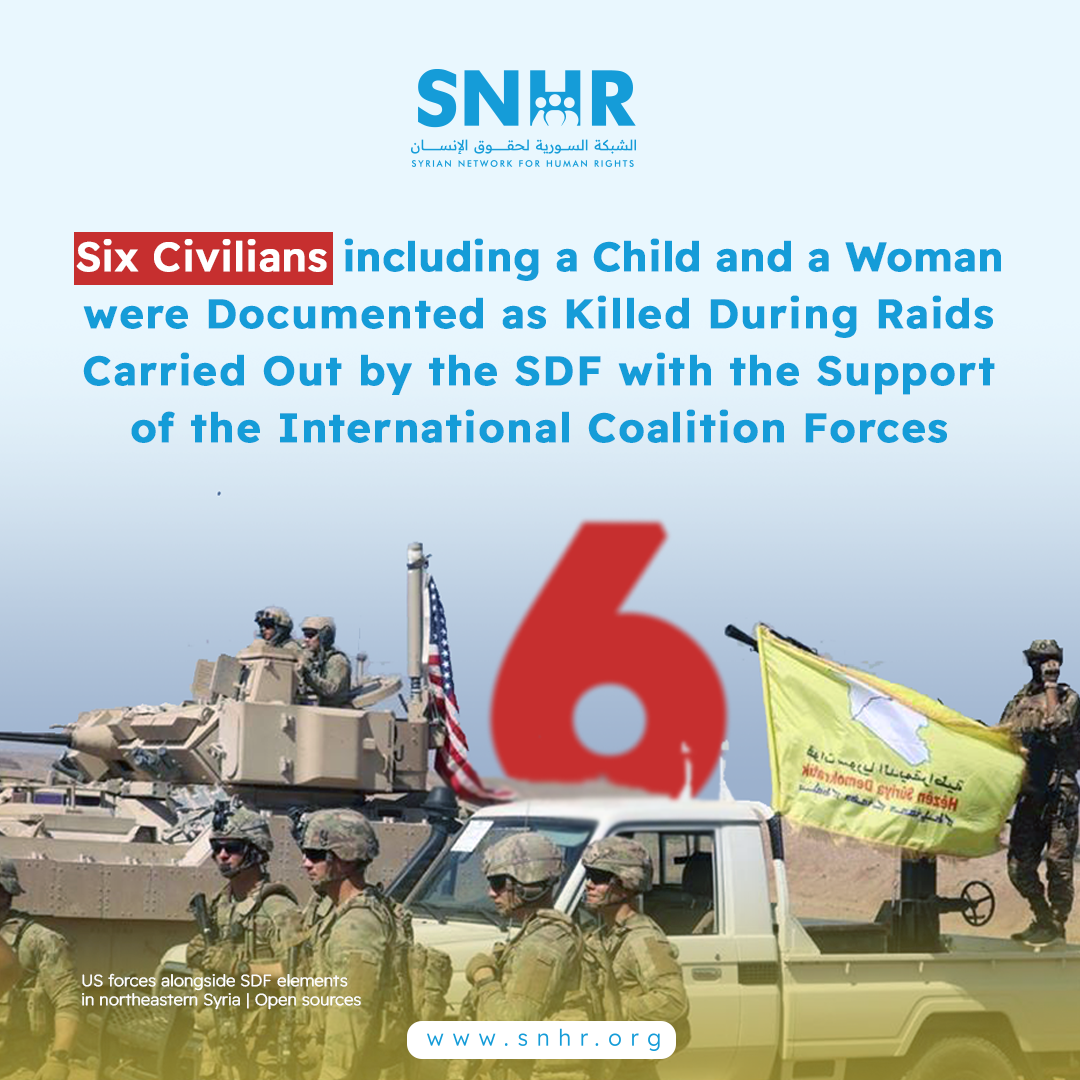
Damascus – The Syrian Network for Human Rights (SNHR) today released a briefing documenting the killing of six civilians, including a child and a woman, in two separate incidents that occurred during raids conducted by the Syrian Democratic Forces (SDF) in the town of Theiban in the eastern Deir Ez-Zour countryside on December 21, 2025, and the town of Jadida Kahit in the eastern Raqqa countryside on December 23, 2025. These raids were carried out with air support from the International Coalition. The SNHR also documented the arrest of a number of civilians during these raids without warrants or any legal justification for their detention.
The report details the two incidents and condemns the killings and arbitrary arrests that accompanied them, which, according to international legal standards, constitute extrajudicial killings. It also provides a preliminary legal characterization of the potential violations and associated responsibilities.
The report stated that forces controlling the town of Theiban in the eastern Deir Ez-Zour countryside, with air support from the international coalition, carried out a large-scale raid and arrest campaign in the town at dawn on December 21, 2025. The campaign resulted in the killing of three civilians, including a child, by gunfire during the storming of residential homes, in addition to the arbitrary arrest of six local residents. The operation included storming several houses, transferring the victims’ bodies to an oil site, and detaining individuals without presenting legal warrants. The campaign was accompanied by a heavy security presence and intense aerial activity, which instilled fear and panic among civilians, without any reported clashes or clear accusations being made.
The report added that on December 23, 2025, a security force, supported by air cover, stormed a civilian home in the town of Jadida Kheit in the eastern Raqqa countryside, under the pretext of searching for a wanted individual. The operation resulted in the killing of three civilians from the same family, including an elderly woman, by direct gunfire inside the house, without any recorded clashes or armed resistance, suggesting a summary execution. Human rights documentation confirmed that the victims were civilians with no connection to any military or security activity. Later, the perpetrators justified the operation with security claims, without providing any evidence or judicial warrants. According to local testimonies, the operation was an act of collective punishment related to the family’s connection to a wanted individual, rather than being motivated by direct security concerns.
The Syrian Network for Human Rights continues to conduct investigations into the two incidents mentioned in this report, including reviewing and collecting further evidence and information.
The report indicated that the Syrian Network for Human Rights strongly condemns the killing of six civilians, including a child and a woman, during raids carried out by the Syrian Democratic Forces in the rural areas of Deir Ez-Zour and Raqqa, and affirms that the killings that occurred are extrajudicial killings carried out through summary or arbitrary procedures, and constitute a serious violation of the right to life guaranteed under international human rights law, in addition to the arbitrary arrests that accompanied those operations without legal basis.
The report stated that the facts indicate that the killing of six civilians during night raids without clashes or imminent threat constitutes extrajudicial killing and summary execution, prohibited under international human rights law. Firing inside homes also constitutes excessive and disproportionate use of force, violating the principles of necessity and proportionality. Raids and arrests without warrants constitute arbitrary detention and violate guarantees of liberty and a fair trial. These incidents reveal a disturbing pattern of violations and a failure to protect civilians, warranting independent and transparent investigations leading to accountability. Furthermore, the involvement of the international coalition’s air cover raises potential liability that warrants investigation in light of the principle of shared responsibility.
The report concluded with recommendations to stakeholders:
- Immediate cessation by the Syrian Democratic Forces of the use of lethal force during raid operations, strict adherence to the principles of necessity, proportionality and protection of civilians, opening independent and transparent investigations into all documented killing incidents, and holding those responsible accountable.
- Immediately release all those arbitrarily detained, or refer them to the competent judiciary in accordance with fair trial guarantees, and reveal the fate of all those arrested during the recent security campaigns.
- The international coalition forces must review the rules of engagement and support mechanisms provided to the Syrian Democratic Forces, ensure that they are not involved, directly or indirectly, in operations that violate international human rights law, and open an internal investigation into the extent of their compliance with their legal obligations.
- The United Nations and relevant international mechanisms must seriously monitor these violations and exert the necessary pressure to ensure accountability and prevent the recurrence of extrajudicial killings in northern and eastern Syria.
- SNHR affirms the right of victims and their families to redress and reparation, including fair compensation and guarantees of non-repetition, in accordance with relevant international standards.
- The Syrian Democratic Forces must establish a permanent and effective internal investigation mechanism, functionally independent from the field command chain, to receive and investigate complaints regarding killings, abuse of force, and detention, while ensuring the protection of whistleblowers and witnesses and preventing any acts of reprisal against them.
- The Syrian Democratic Forces must suspend the duties of elements suspected of involvement in killings, unlawful use of force, or arbitrary arrests until investigations are completed, refer those involved to disciplinary and criminal accountability bodies, and publish the results of investigations and accountability measures publicly to the extent permitted by witness protection and procedural integrity.
- The Syrian Democratic Forces must adopt written and binding protocols for raids and arrests, including clear rules for the escalation of force, a ban on firing inside residences except when there is an imminent threat to life, requiring personnel to identify themselves and demonstrate the basis for arrest, and documenting operations in the field through official records and body cameras wherever possible.
- The Syrian Democratic Forces must ensure effective judicial oversight of deprivation of liberty by establishing an immediate referral pathway to a competent judicial authority, enabling detainees to contact a lawyer and inform their families of their place of detention, and establishing a central, public register with a minimum of basic data on detainees that allows verification and reduces the risks of enforced disappearance.
- The international coalition should adopt an independent and enhanced verification policy before providing any air or logistical support for law enforcement operations, including assessing the risk of harm to civilians, verifying the existence of a legal and procedural basis for raids, and suspending support when there are serious indications of violations or a lack of sufficient safeguards.
- The international coalition must open transparent internal investigations into the role of its units or air assets in the two operations, determine whether pre-strike or pre-support verification procedures met the standard of due diligence, and announce the results and remediation plans, including reparation if a direct or indirect contribution to violations is proven.
- The international coalition must establish a formal mechanism for receiving civilian complaints, documenting and verifying damages, providing an effective compensation or redress pathway, and ensuring cooperation with independent investigative bodies, including providing them with non-sensitive data necessary to assess the facts, such as flight patterns, coordination, and relevant operational communications where possible.
- The United Nations, and in particular the Office of the High Commissioner for Human Rights and relevant special mechanisms, should activate regular monitoring of these incidents, demand that the de facto authorities take time-bound corrective actions, including investigation, accountability and guarantees of non-recurrence, and include these incidents in periodic public reports.
- Independent international mechanisms concerned with Syria should strengthen the collection and preservation of evidence related to the unlawful use of force, extrajudicial killings and arbitrary detention in accordance with evidentiary standards, in order to support future national or international accountability pathways, while giving priority to witness protection and data integrity.
- The judicial authorities and local police forces already in place in northern and eastern Syria must develop legal oversight frameworks for law enforcement, including clear rules for arrest and search, complaint procedures, the independence of prosecution and investigation, and the prevention of extrajudicial detention.
- Donors and supporting countries should link any institutional, training, or logistical support to concrete compliance measures, including written policies on the use of force, effective internal investigation mechanisms, transparency procedures, mandatory training on international human rights law, with periodic reviews to measure compliance and the possibility of suspending support in case of non-compliance.
- Local and international human rights organizations should intensify field monitoring, document testimonies and material evidence, provide legal assistance to victims and their families, support complaint mechanisms, and work to build accountability files that can be referred to competent judicial authorities, without compromising the confidentiality and security of witnesses.
- The Syrian Democratic Forces and relevant authorities must establish a formal and regular channel of communication with the families of the victims and the local community, including immediate notification of the facts, handing over the bodies in accordance with human dignity procedures, providing reliable information on the progress of the investigation, and adopting initial reparation measures, including psychological, social and relief support when needed.
- Emphasizing the right of victims and their families to redress and compensation, including restitution, fair compensation, rehabilitation, and guarantees of non-repetition, while establishing a practical mechanism for assessing, documenting, and disbursing compensation, and ensuring that administrative settlements are not used as a substitute for criminal accountability when there are serious indications of crimes being committed.
