


SDF Still Holds At Least 3,705 Forcibly Disappeared Persons and Has Killed 122 People under Torture Since Its Establishment
Available in:
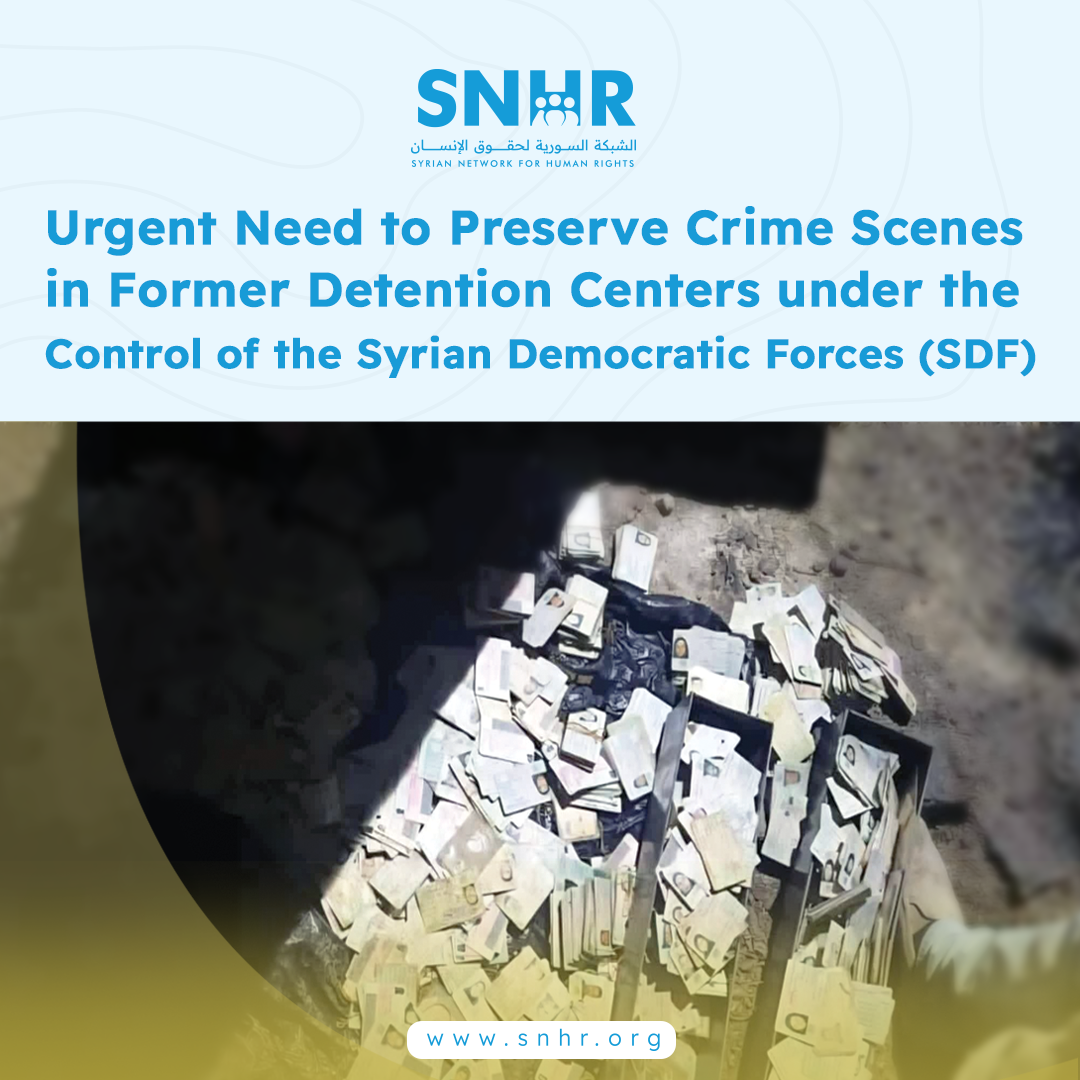
Damascus – The Syrian Network for Human Rights (SNHR) issued a report today stressing the urgent need to preserve crime scenes in former detention centers under the control of the Syrian Democratic Forces. The report stated that the transfer of control over a number of detention centers in northeastern Syria from the Syrian Democratic Forces to the Syrian government represents an urgent challenge in protecting evidence related to serious human rights violations and preventing its loss or tampering. This shift was accompanied by the emptying of some prisons, the transfer of control over others, or the continued administration of still others by the Syrian Democratic Forces, which increased the risk of losing crucial evidence. According to documentation by the Syrian Network for Human Rights, these facilities included prisons in the Raqqa, Hasaka, and Deir Ez-Zour governorates, and held a diverse range of detainees, including those arrested on political and security grounds, opposition activists, individuals detained on criminal charges, as well as women, children, and members of ISIS.
The Syrian Network for Human Rights (SNHR) database indicates that the Syrian Democratic Forces (SDF) bear widespread responsibility for patterns of arbitrary detention and systematic violations, including killings, arbitrary arrests, enforced disappearances, torture, and ill-treatment within their detention centers.
From its establishment in July 2012 until January 23, 2026, the Syrian Network for Human Rights (SNHR) documented the involvement of the Syrian Democratic Forces (SDF) in a series of serious violations against civilians. The SNHR documented at least 3,705 cases of enforced disappearance, in which individuals were detained without any information about their fate or whereabouts, depriving their families of any official information. Torture and ill-treatment within detention centers resulted in the deaths of 122 people, including 5 children and 4 women, and involved various forms of physical and psychological abuse. In addition, direct acts of violence resulted in the deaths of 1,806 civilians, including 317 children and 211 women, clearly demonstrating the devastating impact of these violations on civil society.
Between December 8, 2024 (the fall of Bashar al-Assad Regime), and January 23, 2026, SNHR documented the killing of 204 civilians, including 24 children and 19 women, and at least 819 cases of arbitrary arrest, along with at least 15 cases of torture and ill-treatment, including a child and two women. Verification and updating of this data are ongoing. The gravity of these violations necessitates immediate action to preserve evidence, ensure accountability, and uphold the rights of victims within the framework of transitional justice.
The report emphasizes that the transfer of control over detention facilities means the Syrian state assumes direct legal responsibility for investigating past violations, preserving evidence, and preventing impunity. International law obligates it to conduct prompt, independent, and effective investigations into deaths and serious violations, to treat detention centers as crime scenes, and to maintain the chain of evidence. International instruments also require the maintenance of accurate records and the reporting of deaths and torture, as well as the preservation of all evidentiary material necessary for national and international prosecution.
The report argues that operational necessities are a critical factor, as any failure in collecting, preserving, or documenting evidence could lead to its exclusion in court, thus undermining victims’ rights to truth and justice. Past experience demonstrates the very real risks of evidence loss due to deliberate destruction, uncontrolled access, or environmental degradation. Administrative records, the physical infrastructure of detention facilities, and digital evidence are essential elements that require immediate action and a rigorous archiving chain to ensure their integrity and admissibility in court.
In closing, the Syrian Network for Human Rights called on the Syrian authorities to immediately secure all detention centers that were under the control of the Syrian Democratic Forces and are now under the control of the government, by deploying trained security personnel to establish physical protection zones, implementing strict entry protocols that require written authorization and full documentation, and preventing any removal, destruction, or transfer of evidence from the sites. The authorities were urged to issue a public statement affirming their commitment to preserving evidence as a fundamental principle of accountability and justice. They were also called upon to enact emergency regulations stipulating criminal penalties for anyone who tampers with, destroys, or removes evidence from protected sites. Furthermore, the Syrian government was urged to expedite the conclusion of formal cooperation agreements with the International, Impartial and Independent Mechanism for Syria, the International Commission on Missing Persons, and the United Nations Commission of Inquiry, granting these bodies access to collect evidence in accordance with international criminal standards. The importance of implementing systematic documentation protocols, including comprehensive photographic and video recordings, the preparation of crime scene records, and the cataloging of all evidence to ensure its reliable traceability and management, was emphasized.
SNHR noted that, with regard to al-Hol camp, immediate measures should be taken to document the identities of all detainees and the circumstances of their detention, initiate legal procedures for the release of those detained without legal basis, and preserve all records that may substantiate individual cases of arbitrary detention, family separation, and deaths in detention. Furthermore, establishing information centers that enable families to report missing persons and provide pre-death data is crucial to supporting future identification efforts.
The report emphasized that the evidence held in these centers, if protected and professionally processed, could meet the requirements for criminal accountability, truth-seeking, and identifying victims, particularly those forcibly disappeared years ago. Conversely, the loss of evidence due to damage, contamination, or tampering represents an irreparable loss, not only for individual prosecutions but also for the overall historical record of violations committed against the Syrian people.
